The Manifestation of Ideology
Updated: Sep 8, 2025
Abstract
Ideology is expressed in the built environment of our everyday lives. Cultural interpretation of materiality that composes architectural sites can give insight into the lives of people through a historical lens. Furthermore, media-based objects, such as newspapers and travel brochures, function as ideological value indicators for geographic regions. Interpretations of tangible and intangible cultural characteristics can be understood through analysis of the built environment, material objects, and historical media. Studies that focus on the communicative properties of landscape generally evaluate the legacy and impacts of ideologically driven spaces. Such studies rarely make in-depth assessments into how materiality is used to express ideologies or how those expressions are interpreted. In other words, how is ideology manifested from the abstract realm in the public sphere. The aim of this paper is to examine how landscapes are ascribed ideological values and how those values diffuse throughout populations. Due to limited research in this capacity, this paper will explore how to translate theoretical foundations to methodological approaches regarding how ideology is manifested.
This paper is divided into four parts. Part one looks at fundamental concepts (the Peircian Model and Barthes’s tri-dimensional pattern) in communication to establish how theoretical components can be translated to methodology. Part two looks at theories in the social sciences that complement the Peircian Model and tri-dimensional pattern to express consumption driven ideology while reinforcing social stratification and hierarchies. Part three explores the work of Jean Baudrillard’s Simulacra and Simulation in how media technology disrupts the natural order of communicative properties. Finally, this paper looks at a three-part conceptual framework of ideological framing in vernacular semiotic landscapes. One could argue that is possible to take fundamental communicative properties and leverage their theoretical foundations into measurable methodological approaches. The manifestation of ideology is an identifiable process and may be quantifiably measured in such a way that may yield subjective cultural interpretations.
Introduction
Communicative properties of landscape can be leveraged to understanding how ideology infiltrates social spaces. Comprehension of such processes is important because it can demonstrate how ideologically driven myth-making is utilized to create social barriers to the accessibility of resources. By breaking down the communicative properties of landscapes, one can devise a research methodology to identify how social barriers are established and how to use that data to inform the public in the hopes of enticing critical thinking and engagement with their communities. Through comprehension on how ideology shapes worldviews and perceptions of reality, we can reflect upon ourselves to gauge corruption within our own value systems.
Part I: The Peircian Model & The Tri-Dimensional Pattern
Understanding the manifestation of ideology may begin with Charles Sanders Peirce and his triadic model. The model’s component of interest, the third element, makes the Peircian model truly distinct from the Saussurean dyadic model, which is philosophically like the Cartesian concept that suggests, ideas are perceived introspectively in the mind, or that meanings are intuited (Hoopes, p.7, 1991). Peirce would counter Descartes with a framework that recognizes every “thought is a sign without meaning until interpreted by a subsequent thought” (7). The third element’s importance lies in the interpretant, which functions as the subsequant thought providing meaning to the interpretation of the perception (7).
The Peircian concept of Thirdness has characteristics of importance for assigning meaning to ideas. Hoppes succinctly defines the three concepts…
· Firstness is the existence of things
· Secondness is the reactive relationship between things
· Thirdness is representational of relations among things (10)
The Peircian Model accounts for the interpretant’s capacity to assign meaning to be influenced by external social conditions. Peirce describes the role of Thirdness as mediation, which is the mechanism that assigns identity between subject and object (Peirce, p.191, 1991). One function of the interpretant is to coordinate second order concepts. Meaningful subsequent thoughts are considered when Peirce states, we observe our own feelings by a reflective sense (191), which supports his notion that Thirdness also functions as the ‘voice of conscience’ (195). By referring to thirdness as the voice of consciousness we are now pulling abstract material from the conceptual realm into the physical. Peirce describes the quality of the triadic model as operating relations of reason and self in that they both “arise from the mind setting one part of a notion in relation to another” (195). The relations between reason and self are mediated through external influences that are constituted by layering actions (or thoughts) upon another (195). Contextually speaking, Peirce is discussing reason as the application of meaning, as-well-as, self as self-identity, both of which are built upon the influence of second-order systems that layer new knowledge with preconceived knowledge.

Saussurean Model: Knowledge is intuitive.
Peircean Model: “…thought is a sign without meaning until interpreted by a subsequent thought" (Hoopes, p.7, 1991)
Interpretant
• Functions as subsequent thought
• Provides meaning to sign
We can now direct our attention to the relationship between the sign, signifier, and signified in accordance with Roland Barthes. The relationship’s model may be known for its cyclic illustration of signifier and signified merging together to form a sign, which in turn, becomes a signifier to merge with a signified (Barthes, p.113, 1991) and on and on. To understand the diffusion of ideology we may consider the properties of mythmaking, which have their roots in fundamental concepts. The sign, which is the basic unit of language, consists of two integrated parts; The signifier and the signified (Rose, p.74, 2001), which are united in the mind by an associative link, thus only functioning as psychological entities (Chandler, p.17, 2021). Independently, the signifier attaches mental representations of sound (17) or image to a signified; (Rose, p.74). The function of a signified is to be the relational concept, or as a linguistic ‘value’ (Chandler, p.17). Barthes model is really a tri-dimensional pattern where one can start with the signifier as an expression of the signified (Barthes, p.111). Signification occurs when a mere signifier, like a stone, is signified with ascribed values or weight (e.g., Strength or Unity), then the signifier becomes a sign (112). When discourse is processed through the Peircean Triadic Model and Barthes’s tri-dimensional pattern, one can understand how the process of assigning meaning and identity may be corrupted.

Roland Barthes’s tri-dimensional pattern is important because it demonstrates a
semiological schematic (112) that gets to the point of meaning corruption when applied to mythmaking through the introduction of second-order systems. Recall the relationship chain of signifier, signified, and sign. The myth takes hold by implanting itself into the signified thus establishing as a reconstitution of cause and effects (116). The contamination of the signified is made possible by accessing second-order systems that are facilitated through appropriation. The second-order system is introduced as a symbol and expressed as a sign, thus creating the materials of mythical speech in the form of language, rituals, and pictures (113). Barthes contends that the resulting mythical concept is to be appropriated as an external entity whose meaning is already complete and has the capacity to ascribe information in the form of memory, facts, and decisions (118). The process of appropriating information in this fashion is second order in that the information comes pre-loaded and external, which is why Barthes describes the process as parasitic. Gillian Rose identifies the point of connection between a signifier and a signified may be called into question and explored (Rose, p.74). The communicative properties of material objects may be leveraged as sources of empirical data that transcends the abstract and physical realms through material analysis and cultural interpretation.


Part II: Cultural Capital, Ideology, and Media
Cultural Studies of media demonstrate how second-order systems may be appropriated through advertisements and public discourse. Ideology also works through the appropriation of loaded symbols. Regarding external influences, recall the layering properties of mediation between reason and self to understand how ideologically driven myths shape worldviews on a mass scale. Stuart Hall identifies external influences in that ‘culture’ refers to the arrangement of social existence assumed under determinate historical conditions (Hall, p.300, 2019), appropriated, through an ensemble of relations and structures exhibited as an ‘identifiable configuration’ whose knowledge is based upon man’s

mastery over nature (302). A notable example is his work on the myth of mastery over nature, a myth that has been abstractly stored and materialized in production while being preserved and transmitted through language (302). Broadcast discourse, such as advertisements, are designed to be ubiquitous while retaining the capacity to be distributed through different forms of technical media (Williamson, p.11, 1983). Advertising ascribes value onto the signifier to create structures of meaning (11). Hall’s analogy of man’s mastery over nature offers an ideal example of mythmaking. Naturally, humans must establish a stable geographic territory to acquire needs but that is not the same as mastering nature, which has been made evident with the global climate crisis (or any local ecologically-based crisis). The myth of mastering nature was introduced as a corruption to the tri-dimensional pattern. Hall refers to the manifested culture that has emerged from the accumulation power over nature to be man’s ‘second nature,’ which is derivative of second order semiological systems. Similarly, Williamson’s description of how advertising creates false categories of identity is consistent to Barthes’s tri-dimensional pattern where the signifier is impregnated with contaminated values. She states that false categories obscure social structures of class (identity) with the distinctions made by the consumption of goods thus producing the consumer identity (13).
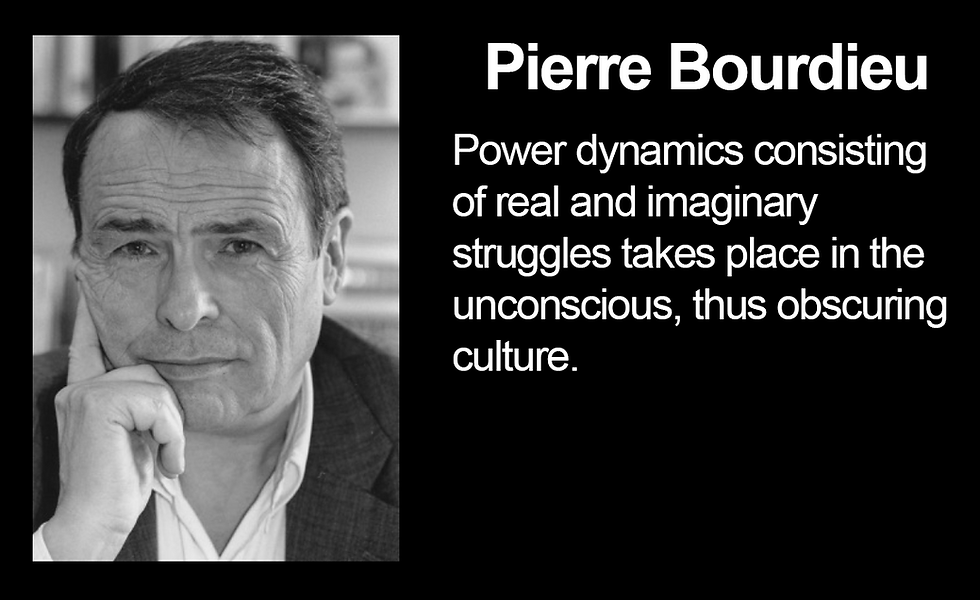
Thus far we have looked at models that illustrate how a corrupting agent, like ideology, can be introduced as an external influence. Media’s compounding effects of ubiquity impresses value systems shaping an individual’s appearance and behavior. Hall’s example, the myth of man’s mastery of nature, describes how aggregate social order can be established. In Distinction, Pierre Bourdieu describes the emergence of social stratification through the accumulation of cultural capital that in turn reinforces the trappings of habitus. Bourdieu defines habitus as a system of dispositions based upon the different ways of relating to presupposed social conditions built from realities and fictions and their belief in the realities they simulate (Bourdieu, p.5, 1984). Habitus can be described as behavioral predispositions, or conditioned responses, to anticipated experiences. The complementary component, cultural capital, is divided into three categories. The first is embodied, which come in forms communicated through speech, dress, and posture (106). Objectified capital comes in the form of materiality with items such as artworks, books, and furniture (71). Institutionalized capital is ascribed through measurable competencies such as technical qualifications and recognized awards (13). To use more contemporary language, Bourdieu is discussing various forms of social barriers whose constraints are predicated upon generational privilege. A person born into a particular class status is marked by how they talk, by how they are educated, and their material possessions. For example, a real estate agent selling luxury condos overlooking Central Park would quickly realize that a potential buyer, who is upper middle-class, will not have the resources for such a purchase despite being well educated and dressed. A savvy agent would notice the difference between marks such as an outdated Louis Vuitton handbag (middle-class) from this season’s Hermes (social elite). Hence, distinction.
The forms of cultural capital extend beyond an individual’s identity and into the larger social realm. Bourdieu would argue that the condo example mentioned above would be an be representative of a person going outside of their ‘field,’ or the sets of norms imposed to control production and consumption (3). The rigidity of fields comes from the temporal differences that produce an inflexible social order based on the legacy of successions (72). Ideological prejudices become ‘well-grounded illusions’ because they are based on an immersive process of gaining experience and knowledge acquired pre-verbally (74). At this point, we can begin to see how geographic space is socially constructed through divisions based on class, race, and even gender. Cultural competence is acquired as a source of inculcation, or markedness, in relation to a particular field that defines values (67). Ultimately, habitus is cultivated amongst the privileges of structural relationships based on education and social origin that produce competencies (66).
In The Production of Space, Henri Lefebvre discusses how power is achieved through the appropriation of reality that gives dominion over culture, or visual space. Lefebvre completes Hall’s example of man’s mastery of nature from abstract myth to the social realm. Like Bourdieu, Lefebvre states that the unconscious is created through a unique process of relentless reproduction and repetition at the bodily, linguistic, imaginary, and real experiences of the natural and social worlds (Lefebvre, p.208, 1991). The process of appropriating reality through abstractions of power dynamics consisting of real and imaginary struggles takes place in the unconscious, thus obscuring culture (208). Consequently, consciousness as a locus of knowing misapprehends itself characterized by the misunderstandings driven from ideological mythology (210). The architecture of space is set forth by spatial dictates expressive of the interests of the dominate culture. Lefebvre states that ideologies do not produce space but rather they are in and of space, where the relations of production produce social space (210). A distinction is drawn between practico-social space, such as schools and military installations, verses that of ideologically driven spaces. Thus, there is space whose use is determined by the availability of resources while there is also space that corrals and divides people’s accessibility based on their cultural capital. Arguably, the former is too ideologically driven, but not in the social sense.

In terms of communicative orders, Lefebvre draws upon language to justify the use of exploitive space. For example, he notes that space is not naturally fragmented among plants and animals, however, architecture requiring the exploitation of resources employees the use of metaphor and metonymy (211) to rationalize production. Therefore, language masks knowledge to create productive spaces determined by its physical fixedness where objects serve as rhythms, reference points, and centers (211). Ideologically driven space may be found where natural and abstract space are intertwined in such a way that conditions the body to succumb to the spatial paradigms (213). The conditioning elements of misunderstanding nourishes attitudes of listening and expectancy enabling visual discourse to overwhelm what is merely audible or touchable (212). Another example can be found in the transformative processes of deindustrialization to the post-industrial landscape that were facilitated through discourse expressive of the emergence of the service-based economy marked by manufacturing
facilities being repurposed as loft apartments, breweries, and entrepreneurial start-up spaces. The habitus of the economically displaced are conditioned to their exclusion from the new landscape that is indifferent to their former contributions and occupational skill sets. Additionally, the displaced may also be perceived by governing bodies as a nuisance.
Part III: Simulation
Perhaps the ultimate level of manifesting ideology lies at the heart of Jean Baudrillard’s simulacrum. As a concept, simulacrum implies the detachment from reality, as mediated through images of the hyperreal where meaning has completely imploded (Baudrillard, p.39, 1994). The hyperreal is characterized by its contrast with the real, which are elements that are limited to a fixed state of reproduction, dependent on systems of rationality, and can be measured under ideal or negative conditions (2). The hyperreal has no such constraints for it may be produced from a radiating synthesis or combination of models (2), in other words, the conditions for its production are virtually limitless because the hyperreal defies natural order. To supplement Hall’s myth on man’s mastery of nature, Baudrillard would contend that the natural order itself is dead. This assessment is made evident where Baudrillard states that signs of perfect description short circuit the real and all its vicissitudes (3). A distinction is made clear from pretending in that the latter leaves reality intact, whereas simulation masks the difference between true & false, and, real & imaginary (3). The reproduction of the hyperreal is analogous to Rolland Barthes’s tri-dimensional pattern for it functions as a group of signs dedicated to their recurrence as signs, however, consistency with reality is not necessarily a desired end (27).
Baudrillard has two models that are of interest to fully comprehend how simulation operates: the Phases of Images and the Three Orders of Simulacra. The phases of the

image are instrumental to interpreting images in their representation as a simulacrum. The first is the reflection of profound reality and may be considered an image of good appearance (8). The remainder three phases gradually usher in a status of simulacra. The second phase is noted by acting as a mask and denatures reality and is hence marked as an evil appearance (8). The third order masks a profound absence of reality thus leaving the final order expressive of being completely void of any relation to reality; the fourth order is a simulation (8). Conceptual development is achievable when the phases of images are taken in conjunction with the three orders of simulacra. The first order is natural; characterized by the optimistic aim of an ideal expression of nature (140). The second order is productive and its aim is the expansion of material power (140). Of course, the final order is that of simulation whose aim is total control.
Notation should be made that the concepts presented in the book Simulacra and Simulation are in the context of media representation. Methodological applications of the framework above is intended to be utilized as a means to critique such consumption. For example, Baudrillard’s critique on the film Apocalypse Now and national coverage of the Vietnam War are not without controversy. I find the critique that the war never happened (71) to be intriguing yet disturbing. His argument for the war as never happening is interesting because it implies that there is detachment between reality and the reality that is presented through media outlets. Perhaps, this context may even be extended to the soldiers who were impressed upon (or attempted to impress) that they were fighting for a noble effort. With that said, it is easy to counter Baudrillard with the assessment that it was real for those who fought or are currently fighting in our contemporary conflicts. The orders of simulacra are on a spectrum of the representation of reality to total simulation. In the context of war, are soldiers engaging in something real or are they caught in simulated matrix manifested through opposing ideologies?
Case Study: Ideological Framing of Vernacular Typography
Introduction
To evaluate a scenario where ideology is manifested, we may look at forms of vernacular typography and their ideological appropriation in Spain. In this case study, two forms of vernacular typography are evaluated through changes in the social conditions over the last twenty-five years. Here, Johan Järlehed looks at how Basque and Galician typographical traditions in their respective regional enclaves have experienced transformations in the utility of their public display. Initially, vernacular typographical features expressed characteristics that were explicitly representative of Basque-ness and Galician-ness. For his study, Järlehed does not go into detail of the typographical history of these communities’ traditions or the particular significance of their type characters’ anatomy, which would have been helpful in better understanding the transformative mechanisms that facilitated the standardization process of appropriation given Spain’s unique political context. However, Järlehed does explain the cultural significance of institutional appropriation of typographic traditions that are simultaneously leading to erasure and commodification of regional identity. The main argument in his study is that the framing of typographical choices are set by competing ideologies within the semiotic landscape. His framing is set around cultural dispositions: resistance, standardization, and commodification.
Historical Context of Case Study
The form and function of typographical features have a rich history. Vernacular typographic forms have indexing properties that identify unique features of social histories through their hand rendered stylings revealing trace evidence expressing locality, authenticity, and connection to a specific time and place (Järlehed, 166, 2015). Basque and Galician type traditions have their roots in religious practices as inscriptions on alters, funerary stones, and crosses (168). Over the course of the nineteenth century, these type characters have become increasingly integrated into the larger semiotic landscape as political expressions of nationalism (168), as well as cultural works of art (170). By the twentieth century, typographical variants emerged into the commercial sphere in a diverse range of communicative genres such as propaganda posters, street signage, and commerce (171). The Basque and Galician types were aesthetically bold and stood out to attract attention (171).
Tensions between proponents of regional and national identity have run high over the course of the last century and a half concerning linguistic and cultural distinctions (182). Since the revised constitutional framework of 1978, newly autonomous communities experienced turbulence and confrontation between local cultures formerly repressed by the Franco regime and the central government in Madrid focused on imposing a uniform Castilian culture (182). Järlehed describes a cultural eroding process in Basque and Galician communities brought on by political institutionalization efforts instigating cultural normalization (182). The temporal effects of normalization became evident in a case where a Basque municipality of Donostia-San Sebastián overhauled their entire street-name signage in 2008, replacing vernacular “Basque” lettering with a generic sans-serif (182). The alterations were not limited to public utilities for banks and other local institutions. Changes from traditional hand rendered signage to a more general aesthetic removed cultural character in the communities through a loss of markedness. The process of designing communicative mediums, like street signs, depends on “the co-existence of past and present linguistic forms, and competing voices of different socio-ideological groupings and traditions” (173). An important component to Järlehed’s argument is that there are ideological tensions pulling at the typographical markedness and unmarked-ness as legitimating ideology across various forms of interest.
In this case study, Järlehed argues that the typographical traditions of Basque-ness and Galician-ness is a contested feature where typographic choices are framed by a set of competing ideologies (166). The contemporary process of the typographic homogenization in cityscapes, brands, and façades, may be contrasted with a growing value of vernacular typography (166). These ideologies interact with a parallel process of enregisterment where vernacular typographic variants become publicly recognized as social emblems of local cultures (166), which have significant value at the community and commercial levels. Furthermore, Järlehed argues that this process of enregisterment interacts with a layering in the contemporary semiotic landscape of three major ideological complexes: cultural resistance, cultural standardization, and cultural commodification (165). Each of these complexes represents a particular set of beliefs and values related to the local culture which is attributed to vernacular typographic forms (165).
Typography as an Indexical Sign
The indexical property of typography is an important consideration for this case study and the notion that ideology is manifested through second order systems. According to Järlehed, the historical development and usage of vernacular typography determines its indexical field, by which he means its social meaning potential (172). By framing typography as an indexical field that involves assigning meaning potential, we can see that there is an element of influence over the signifier. As Chandler notes, indexical signs do not represent or symbolize things (Chandler, 53, 2021) but rather they direct attention typically by pointing away from itself (53). In this sense, vernacular typography on street signs indicates the presence of a certain community of people, such as Basque, within a defined perimeter. In an indexical field, vernacular typography on signage communicates that the reader is in a geographical Basque region functioning as a contextual cue. In Järlehed’s analysis, he states that the indexicality of vernacular types are continually renegotiated through social reproduction (Järlehed, 173, 2015). The notion of continual social reproduction in a defined region would account for reassignment of meaning through ideological myth-making in which various entities could erode the vernacular presence by appropriating cultural symbols. Järlehed’s conceptual framework is thus predicated upon the assumption that the presence of vernacular typography is culturally motivated as a function of communicating cultural difference (257). The framework then accommodates for differences in use of space be it local community, commerce, or an imposing government.
Cultural Resistance
An empowering feature of vernacular typography is cultural resistance. In this sense, typography may be enlisted for community-building and mobilization to counter a political authority on behalf of local cultures (193). Ideology in the form of resistance may emerge as an emblematic marker of distinction resistant to submissive conformity brought on by nationalist imposition. Scholar, designer, and activist Thressa Moses supplements this notion by stating that a typographic response was initiated through activist-led events (in Minneapolis after the killing of George Floyd) calling for solidarity, justice, and liberation for the Black communities experiencing violence by the police state (Moses, 4, 2022). Resistance against commodification is also resistance against cultural appropriation, which is the adoption of the elements of a minority culture by members of the dominant culture without permission or knowledge about said culture (5). Challenging political institutionalization and cultural standardization within a discourse is a performative measure distinguishing “their” culture and history (Järlehed, 181, 2015).
The situation in Spain is a conflict between national and regional identities and their representation that occurs globally. In a comparable study focused on German-ness in typography, Jürgen Spitzmüller looked at the history of the typeface Blackletter, which has longstanding roots in German heritage. As nationalist parties were vying for power from the fallout of World War One, it was the Nazi party that stigmatized Blackletter as being anti-German and had Jewish associations in a move to make themselves distinct from other party factions (Spitzmüller, 264, 2012). However, as Järlehed argues ideological framing is contentious as made evident in the use of Blackletter in the aftermath of World War Two. Both neo-nationalist and anti-fascist groups reappropriated Blackletter typefaces for use in their own forms of activist propaganda (267). Here, Moses would add that whether art propaganda is used for uplifting or oppressing a society, propaganda is intended to set movement in action (Moses, 8, 2022). The use of typography in political action demonstrates how it can be used as a symbol of community empowerment and othering based on cultural associations.
Cultural Standardization
The mechanics of cultural standardization incorporate the basic functions of reassigning meaning through a reductive process. In Spain, standardization frames reduce the register of cultural markers of the Galicia and the Basque countries making more consistent with national representation while eroding local identity (Järlehed, 194, 2015). Of the three ideological frames, standardization is proactively destructive for it rejects vernacular type, “regarding it as a politically marked and non-desirable cultural product” (177) in pursuit of a neutral medium that transcends social difference (177). Barthes notes that myth can develop its second-order schema from the lack of meaning (Barthes, 131, 1991). The external infiltration of the signifier through second order systems creates floating meanings where language offers myth an entry point through a “halo of virtualities (132).” By this, Barthes is stating the ascription of meaning is a competitive process at the point of signification. An example of this phenomenon is the relentless production of superficial noise generated by media outlets to push their ideological agendas. The messaging process is complex. Here, the removal of vernacular lettering in exchange for generic typography is a form of ideological erasure. The standardized typographical form that replaces the vernacular is the message. The newly imposed lack of meaning is the entry point for a new mythology.
Cultural Commodification
The concept of typography as an empty signifier lends itself well to commodification. According to Järlehed, cultural commodification values vernacular types for economic reasons (Järlehed, 178, 2015). He states that vernacular types are viewed as part of a cultural heritage which can be exploited through place-branding, urban theming, and tourist consumption (178). An interesting point Järlehed makes is that typography used to establish authenticity as a means for attracting foreigners and capital (178), or economically motivated appropriation that is aimed less at residents and more at outsiders. The theoretical foundation set forth by Lefebvre may be considered in that space is designated by dominate cultures. Tensions of interest emerge where the landscape is being homogenized while at the same time there is an interest to present vernacular elements in economically conducive public spaces, such as bars and restaurants (194). As an empty signifier, vernacular typography in this instance becomes less about the local cultures of Basque-ness and Galician-ness but rather the appearance of foreign-ness for the visiting consumer as a semiotic ascription.
Conclusion
Järlehed’s analysis on the ideological framing of vernacular typography supports how to identify the properties that lead to the manifestation of ideology. The case study adds three components of interest: complexity, indexical signs, and floating signifiers. Ideological framing in the public sphere is complex and generally not a total top down system. Public space, though largely controlled by dominant agencies, does offer some space to minority cultures. The commodification of appropriated culture may be a form of resistance or exploitation. Tension in power dynamics can be expressed in indexical signs that are a statement of ideological domains in the public sphere. Finally, floating signifiers as a concept demonstrates how meaning ascription is malleable and subject to change. Typographical associations may emerge as meaningful in one way but can be appropriated and expressed in a contrary or destructive manner.
Bibliography
Barthes, R. (1991). Mythologies. New York: The Noonday Press.
Baudrillard, J. (1994). Simulacra and Simulation. Ann Arbor: The University of Michigan Press.
Bourdieu, P. (1984). Distinction: A Social Critique of the Judgement of Taste. Cambridge: Routledge & Kegan Paul Ltd.
Chandler, D. (2021). Semiotics: The Basics. New York: Routledge.
Giddens, A. (1990). Consequences of Modernity. Cambridge: Polity Press.
Hall, S. (1993). Encoding, Decoding. In The Cultural Studies Reader: Second Edition (pp. 508-517). New York: Routledge.
Hall, S. (2019). Essential Essays: Volume One. Durham: Duke University Press.
Hoopes, J. (1991). Introduction. In C. S. Peirce, Peirce on Signs : Writings on Semiotic (pp. 1-13). Chapel Hill: The University of North Carolina Press.
Järlehed, J. (2015) Ideological framing of vernacular type choices in the Galician and Basque semiotic landscape, Social Semiotics, 25:2, 165-199, DOI: 10.1080/10350330.2015.1010316
Lefebvre, H. (1991). The Production of Space. Cambridge: Basil Blackwell, Inc.
Moses, T. (2022). Amplifying the Black Voice Through Design. Diseña, (21), Article.1. https://doi.org/10.7764/disena.21.Article.1
Peirce, C. S. (1991). Peirce on Signs : Writings on Semiotic . Chapel Hill: The University of North Carolina Press.
Rose, G. (2001). Visual Methodologies. London: SAGE Publications.
Smith, L. (2006). Uses of Heritage. London: Routledge.
Spitzmüller, J. (2012). Floating ideologies: Metamorphoses of graphic “Germanness”. In A. Jaffe, J. Androutsopoulos, M. Sebba & S. Johnson (Ed.), Orthography as Social Action: Scripts, Spelling, Identity and Power (pp. 255-288). Berlin, Boston: De Gruyter Mouton. https://doi-org.ezproxy.emich.edu/10.1515/9781614511038.255
Williamson, J. (1983). Decoding Advertisements: Ideology and Meaning in Advertising. Southampton: The Camelot Press Ltd.

Comments